Is Shiny Smile legit?
Shiny Smile may be a real company, but many customers report issues with fit, durability, and a lack of customer support. If you’re looking for a long-term, custom-fit smile solution, there are more advanced options available than Shiny Smile’s approach.
Introduction: Why Shiny Smile Reviews are Suspect
If you’re searching for a Shiny Smile review, you’re probably wondering one thing: is it actually worth it—or just another cosmetic gimmick?
The short answer: Shiny Smile works for temporary cosmetic improvement, but it falls short for people looking for a natural, long-lasting smile solution.
Here’s what most reviews don’t tell you…
Section 1: The Houston Claim — Examining Location and Corporate Footprint
One of the first trust signals Shiny Smile presents to consumers is its apparent identity as a U.S.-based company, frequently referencing Houston, Texas in its branding and messaging.
For consumers, this signal carries significant weight.
A U.S.-based presence suggests a number of underlying assumptions: that the company operates domestically, that it falls within familiar regulatory frameworks, and that customer support and fulfillment are accessible within the same market. In industries connected to personal appearance—where products are customized and expectations are high—these assumptions often play a central role in purchasing decisions.
At the outset of this investigation, this claim appeared straightforward.
However, when we began reviewing publicly available business registration records, the picture became less clear.
Entities associated with “Shiny Smile Veneers” appear to be connected to registrations in Florida, rather than Texas. While it is not uncommon for companies to register in one state while operating in another, there was limited publicly verifiable documentation clearly tying the company’s operational footprint to Houston.
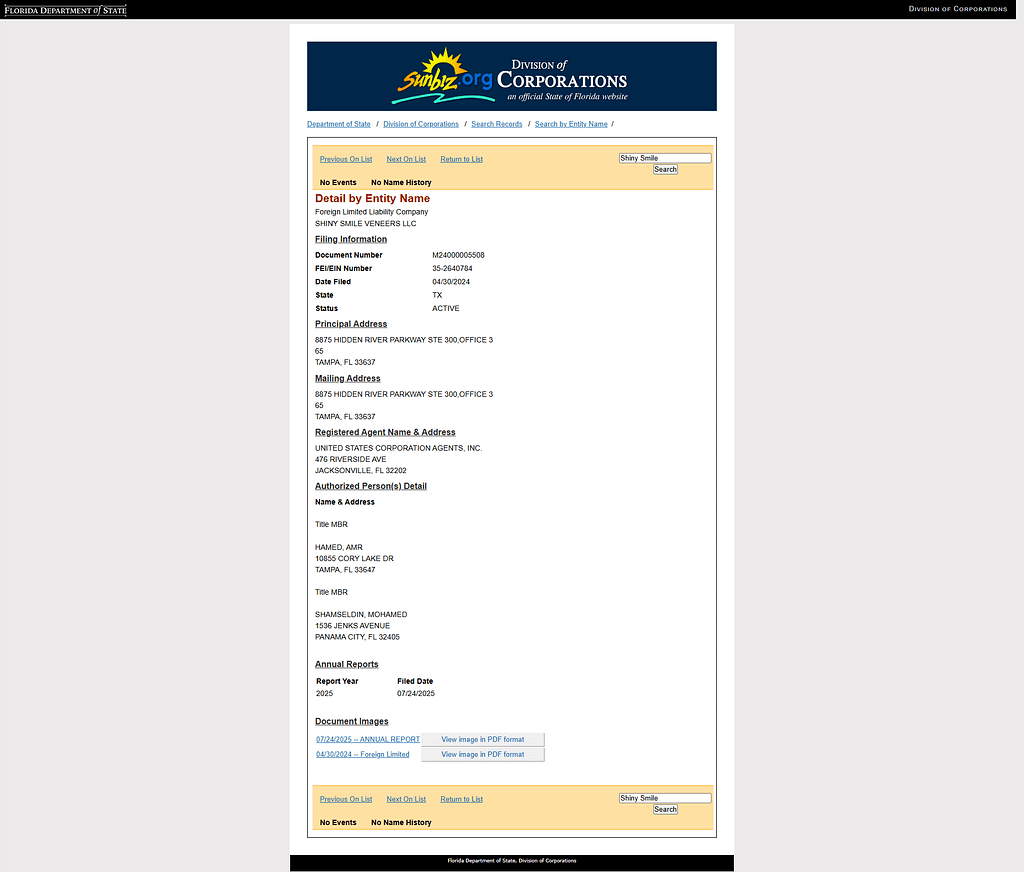
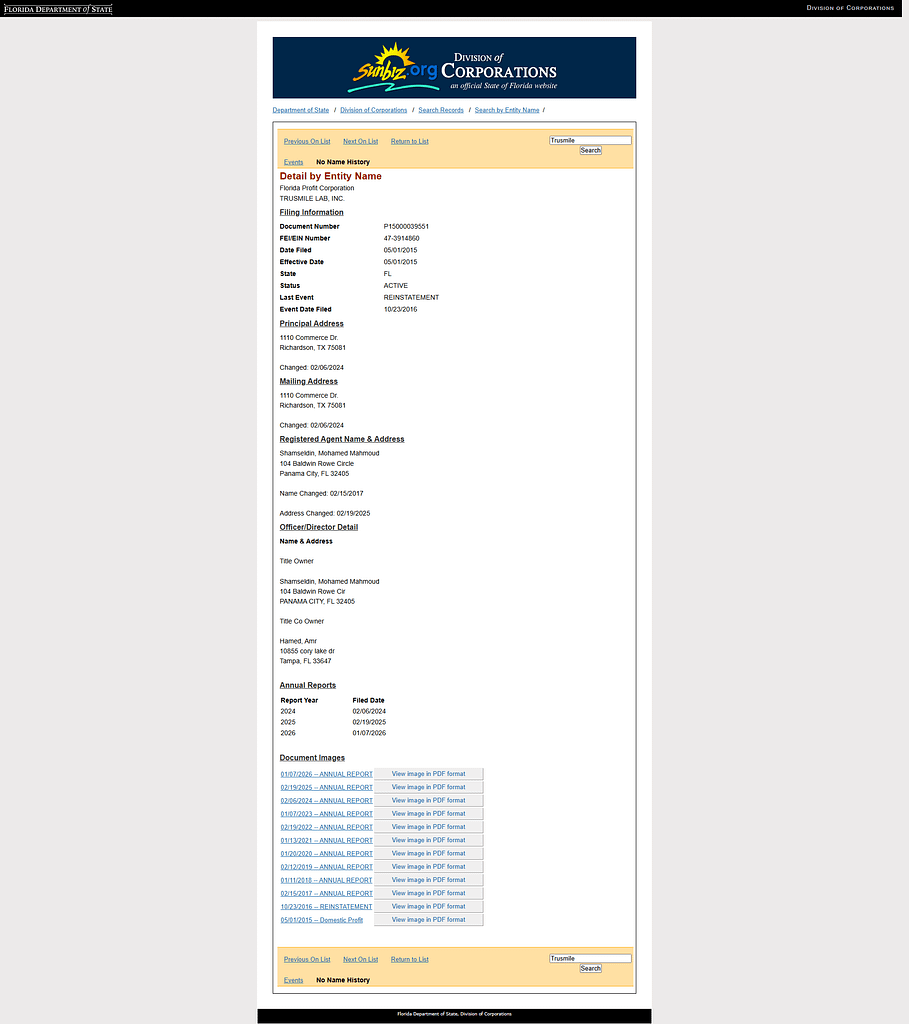
As the investigation continued, we attempted to identify any direct connection between Shiny Smile’s operations and Houston through personnel data.
One individual did appear to provide a potential link.
Jessica Pansera, listed on LinkedIn as a Digital Media Outreach Specialist, identifies her location as Houston, Texas and appears to be associated with Shiny Smile.
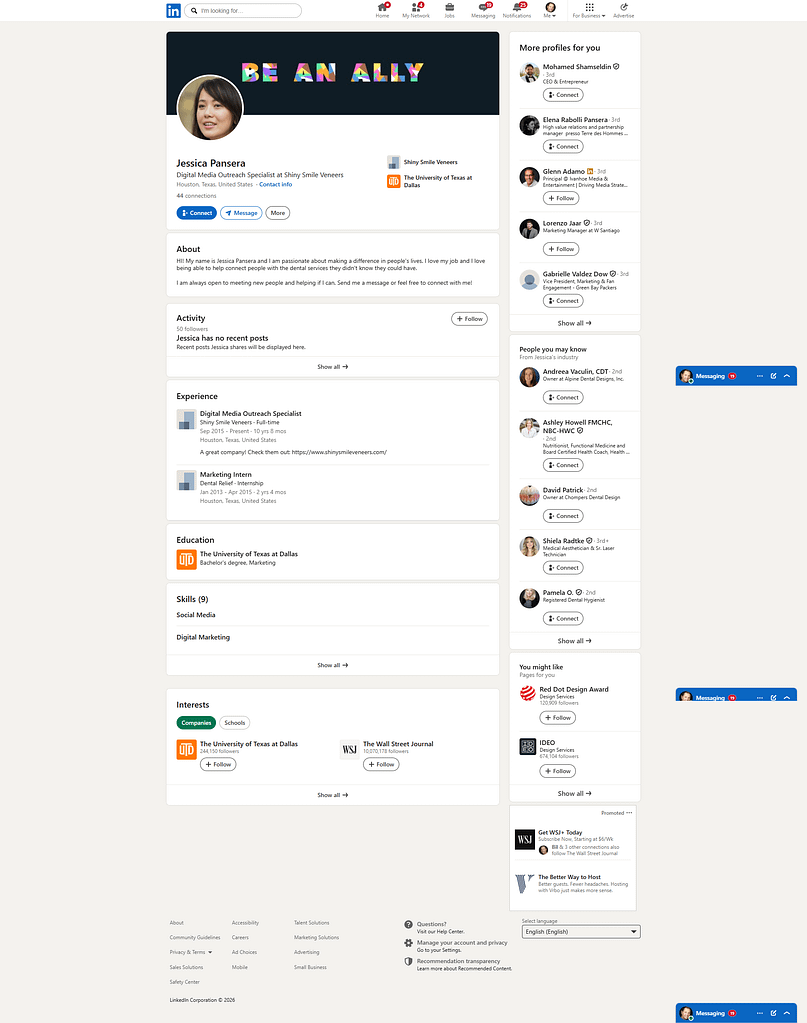
This finding is notable because it represents one of the few identifiable ties between the company and the Houston area.
However, the nature of the role also provides important context.
A Digital Media Outreach Specialist is typically involved in areas such as:
- Marketing
- Partnerships
- Content distribution
- Brand visibility
While these functions are important, they are generally external-facing, rather than direct
Interpreting the Houston Connection
At this stage, the available evidence suggests the following:
- A marketing or outreach presence in Houston (via Jessica Pansera)
- Business registrations linked to Florida entities
- No clearly verifiable concentration of operational roles in Houston
This does not invalidate the company’s U.S. presence.
However, it does refine how that presence may be understood.
Rather than indicating a centralized Houston-based operation, the available data suggests a more limited or partial geographic footprint, with certain functions—such as marketing—potentially located in the United States, while other aspects of the business may be distributed elsewhere.
Why This Matters
Location is not just a technical detail.
For consumers, it functions as a proxy for:
- Accountability
- Accessibility
- Transparency
When a company emphasizes a specific geographic identity, it becomes part of the trust equation.
At this point in the investigation, the question was no longer:
“Does Shiny Smile have any connection to Houston?”
But rather:
“How central is that connection to the company’s actual operations?”
A Pattern Begins to Form
This distinction may seem subtle, but it set the tone for everything that followed.
Because what began to emerge was not a single contradiction—but a recurring theme:
A difference between how the company is presented and what can be independently verified through available data.
And once that gap becomes visible, the investigation naturally moves to the next question:
Not just where the company is connected geographically—but who is involved in running it, and how those roles overlap.
At this stage, the investigation did not reveal a complete absence of U.S. presence—but it did suggest something more nuanced.
A company that appears to maintain select U.S.-based functions, while leaving open questions about where its core operations are actually centered. And that distinction—between presence and operational center—would become increasingly important as the investigation continued.
Section 2: Key Individual Analysis — Mohamed Shamseldin and Overlapping Business Activity
After examining the company’s stated location and corporate footprint, the investigation turned to the individuals associated with Shiny Smile.
Understanding who is involved in a company’s operations often provides insight into how it functions. Leadership, management, and key contributors can reveal patterns that are not immediately visible through branding alone.
One name that appeared consistently in connection with Shiny Smile is Mohamed Shamseldin, based on publicly available LinkedIn information.
According to his profile, Mohamed is associated with Shiny Smile. However, his professional history also suggests involvement in multiple businesses within the same veneer and cosmetic dental category.
This observation introduces an important structural consideration.
In the current e-commerce landscape, it is not uncommon for operators to manage more than one brand simultaneously. Multiple storefronts, distinct branding strategies, and parallel product offerings are often used to test different audiences or market segments.
On its own, this type of activity is not unusual.
However, its significance depends on how those brands are presented.
When companies appear independent—each with its own identity, messaging, and customer base—consumers often assume they are comparing distinct providers. They may rely on differences in branding, reviews, or positioning to guide their decision.
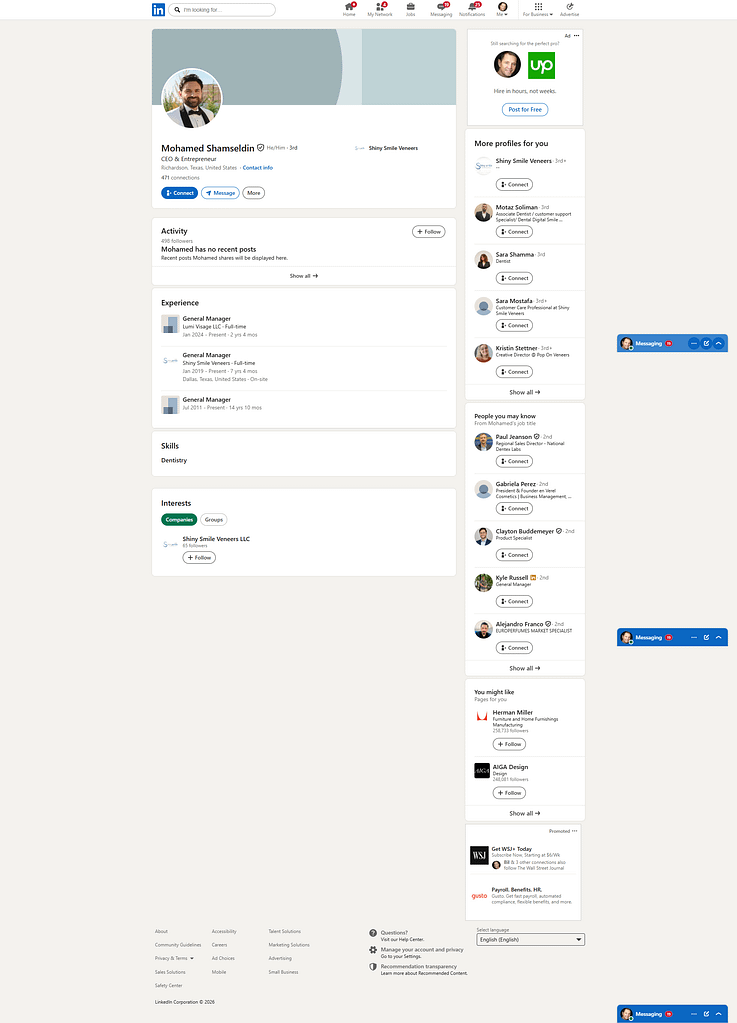
But when the same individual is connected to multiple brands operating in the same space, the context changes.
The comparison is no longer necessarily between independent entities—it may instead reflect different representations of a shared underlying operation.
This distinction is subtle, but important.
It affects how consumers interpret:
- Reviews and reputation
- Competitive positioning
- Perceived differentiation between brands
At this stage of the investigation, the focus began to shift.
The question was no longer limited to:
“Who is associated with Shiny Smile?”
It expanded to:
“How many brands may be connected through overlapping individuals—and how transparent is that structure to the consumer?”
This line of inquiry did not lead to a definitive conclusion regarding ownership or control.
However, it established a second pattern—one that mirrored the findings in Section 1.
Once again, the issue was not a single data point, but a broader theme:
A lack of clear visibility into how the company is structured and how its operations are organized.
And as the investigation continued, that theme became more pronounced—particularly when examining not just leadership, but the wider team associated with the business.
By itself, overlapping involvement across multiple brands is not unusual in modern e-commerce.
But when considered alongside earlier findings, it contributes to a broader pattern:
A structure that is more complex—and less transparent—than the brand’s outward presentation suggests.
Section 3: Team Location Analysis — What the LinkedIn Profiles Reveal
As the investigation moved beyond company-level claims and into the individuals associated with Shiny Smile, the picture began to shift in a more meaningful way.
Up to this point, the inconsistencies we had identified—such as differences between marketing claims and business registrations—could still be interpreted in isolation. It is not uncommon for companies to register in one state while marketing in another, and on its own, that detail does not necessarily indicate a deeper issue.
However, the analysis of team members introduced a new dimension: operational visibility.
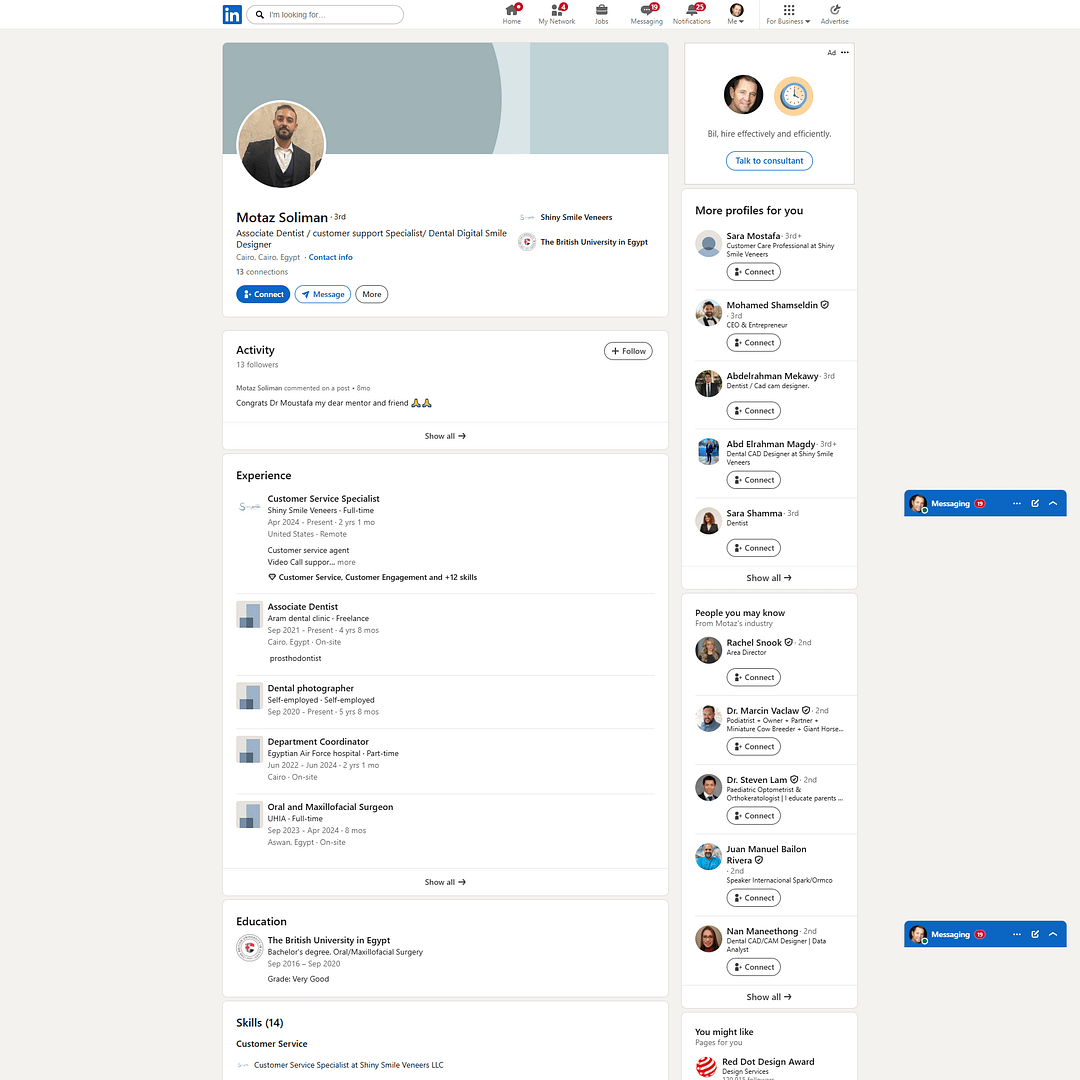
Through publicly available LinkedIn profiles, we identified several individuals who explicitly list Shiny Smile as their employer, while also listing their location as Egypt. This was not limited to a single outlier profile. Instead, it appeared across multiple individuals, each occupying roles directly connected to the core functions of the business.
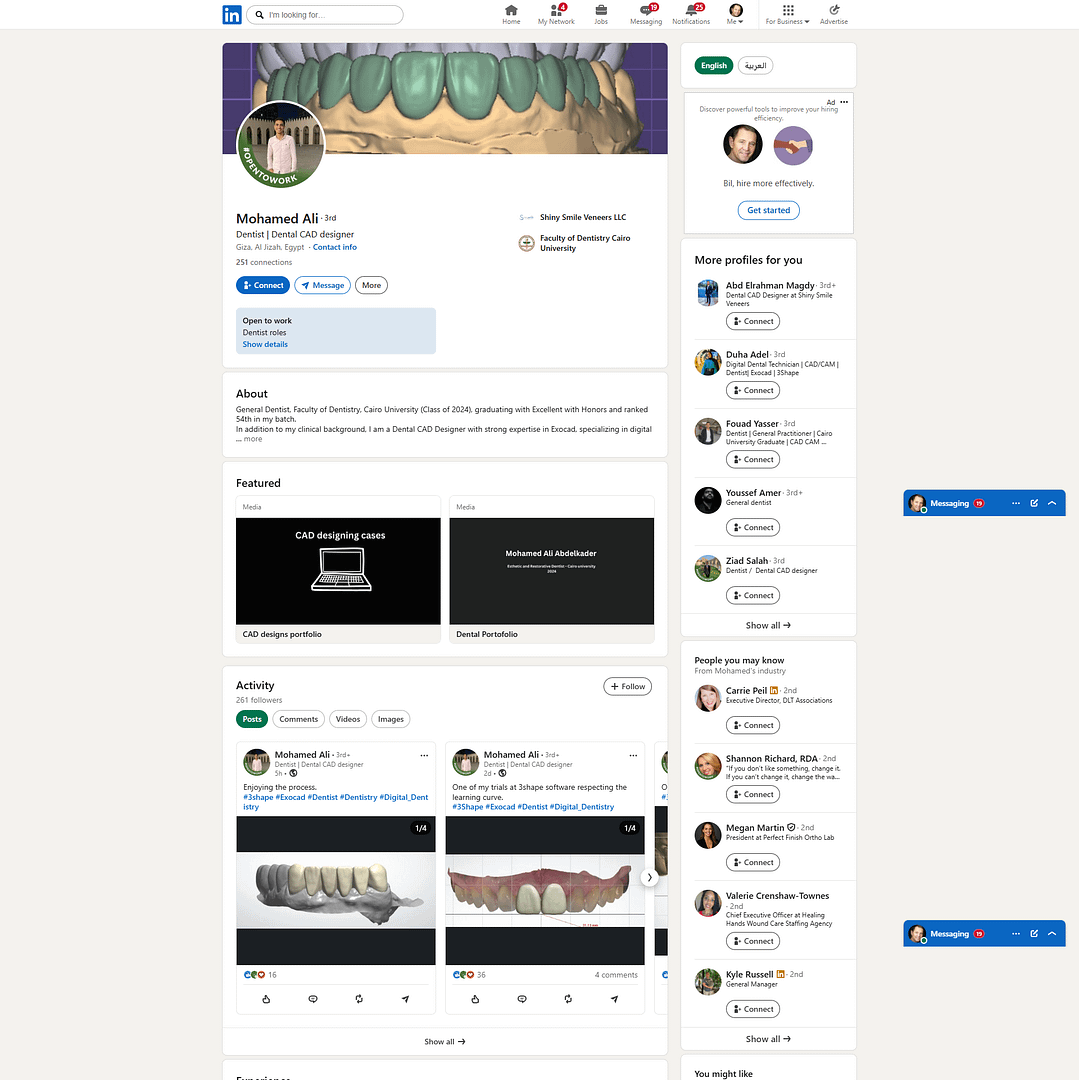
One of the most notable examples is Mohamed Ali, who lists his role as a dental CAD designer. This is a highly specialized position responsible for the digital design and customization of veneers. In other words, this is not a peripheral or administrative function—it is central to how the product itself is created. Mohamed’s profile lists his location as Giza, Egypt.
This alone introduces an important consideration. If the design and technical development of the product are being handled by an individual located outside the United States, it raises a question about where key aspects of production are actually taking place.
A similar pattern appears with Motaz Soliman, whose profile indicates a hybrid role spanning associate dentistry, customer support, and digital smile design. This combination is particularly significant because it connects both sides of the customer experience: the technical creation of the product and the communication with the customer. Motaz also lists his location in Egypt.
This dual role is especially important in understanding operational structure. When the same individual appears to be involved in both designing the product and communicating with customers, it suggests a more centralized or consolidated workflow than what might be implied by a larger, U.S.-based operation.
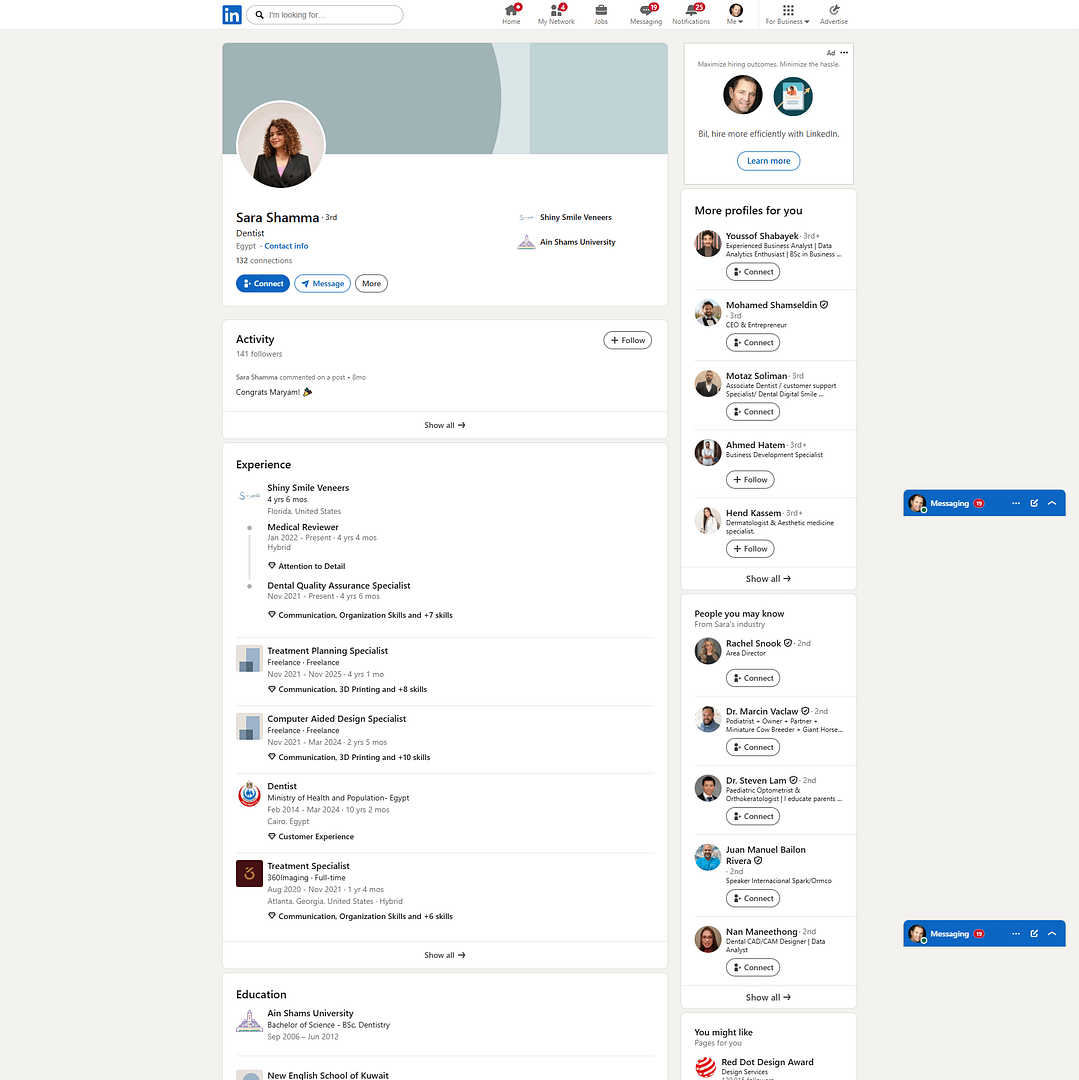
A third example, Sara Shamma, is listed simply as a dentist, again with a location in Egypt. While her profile provides less detail about specific responsibilities, the presence of another dental professional within the same geographic cluster further reinforces the pattern.
Individually, any one of these profiles could be explained as part of a distributed workforce. Many companies operate internationally, and there is nothing inherently unusual about employing talent from different regions.
However, what makes this notable is not the presence of international team members—it is the consistency of the pattern across roles that appear central to the business, combined with the contrast between those profiles and the company’s public-facing positioning.
At this stage in the investigation, three separate signals had emerged:
The company presents itself as U.S.-based, often referencing Houston, Texas.
Business registration records point toward Florida-based entities.
Multiple individuals directly tied to product design, dental oversight, and customer interaction appear to be located in Egypt.
When viewed together, these signals introduce a more complex and less clearly defined operational structure than the marketing alone would suggest.
This does not imply that anything improper is taking place. Global operations are common, and distributed teams are a standard part of modern business.
But transparency matters, particularly in industries where consumers are making decisions about products that affect their appearance and confidence.
When key functions such as design, dental input, and customer support appear to be handled internationally—while the brand emphasizes a U.S.-based identity—it creates a gap between perception and observable structure.
That gap is where uncertainty begins.
And at this point in the investigation, the focus began to shift from isolated inconsistencies to a broader question:
Not simply where Shiny Smile is registered, or who is associated with it—but how the company actually operates behind the scenes.
Because once that question is raised, it naturally leads to the next area of analysis:
Whether similar patterns can be found in the company’s reviews, reputation signals, and third-party endorsements.
Section 4: Review Volume and Patterns — Evaluating the Credibility of Internal Feedback
After examining the company’s structure and the individuals associated with its operations, the next step in the investigation focused on one of Shiny Smile’s most prominent trust signals: its reviews.
For most consumers, reviews serve as a shortcut to confidence. In categories where products cannot be tested in advance—particularly those involving appearance—review volume and sentiment often carry significant weight in the decision-making process.
On its website, Shiny Smile claims to have 6,912 customer reviews.
At first glance, this figure appears to reinforce the brand’s credibility. A high volume of feedback typically suggests a large customer base and consistent product delivery.
However, when this number is placed into a broader context, it raises important questions.
To better understand its significance, it is useful to compare it to established brands operating at a much larger scale. Major beauty and cosmetics retailers such as Sephora, which carry globally recognized products and serve millions of customers, often display review counts in the range of 3,000 to 4,000 per product.
In that context, a relatively niche, direct-to-consumer veneer brand presenting nearly 7,000 reviews associated with its offering stands out as unusually high.
This comparison does not establish a conclusion—but it reframes the context.
Because when a niche, direct-to-consumer product presents a volume of reviews comparable to globally distributed retail products, it introduces a question that cannot be answered by scale alone:
Are these reviews the result of organic customer accumulation—or a system that concentrates and structures feedback differently than traditional retail environments?
Looking Beyond the Number
Volume alone is only one part of the equation.
To better understand what these reviews represent, the analysis shifted from quantity to structure.
When individual reviews were examined in sequence, several patterns began to emerge.
The phrasing across many entries appeared highly consistent, with similar language used to describe outcomes, expectations, and overall satisfaction. While variation is expected in organic feedback, the repetition of tone and structure suggested a level of uniformity that is not typically seen in large, uncoordinated datasets.
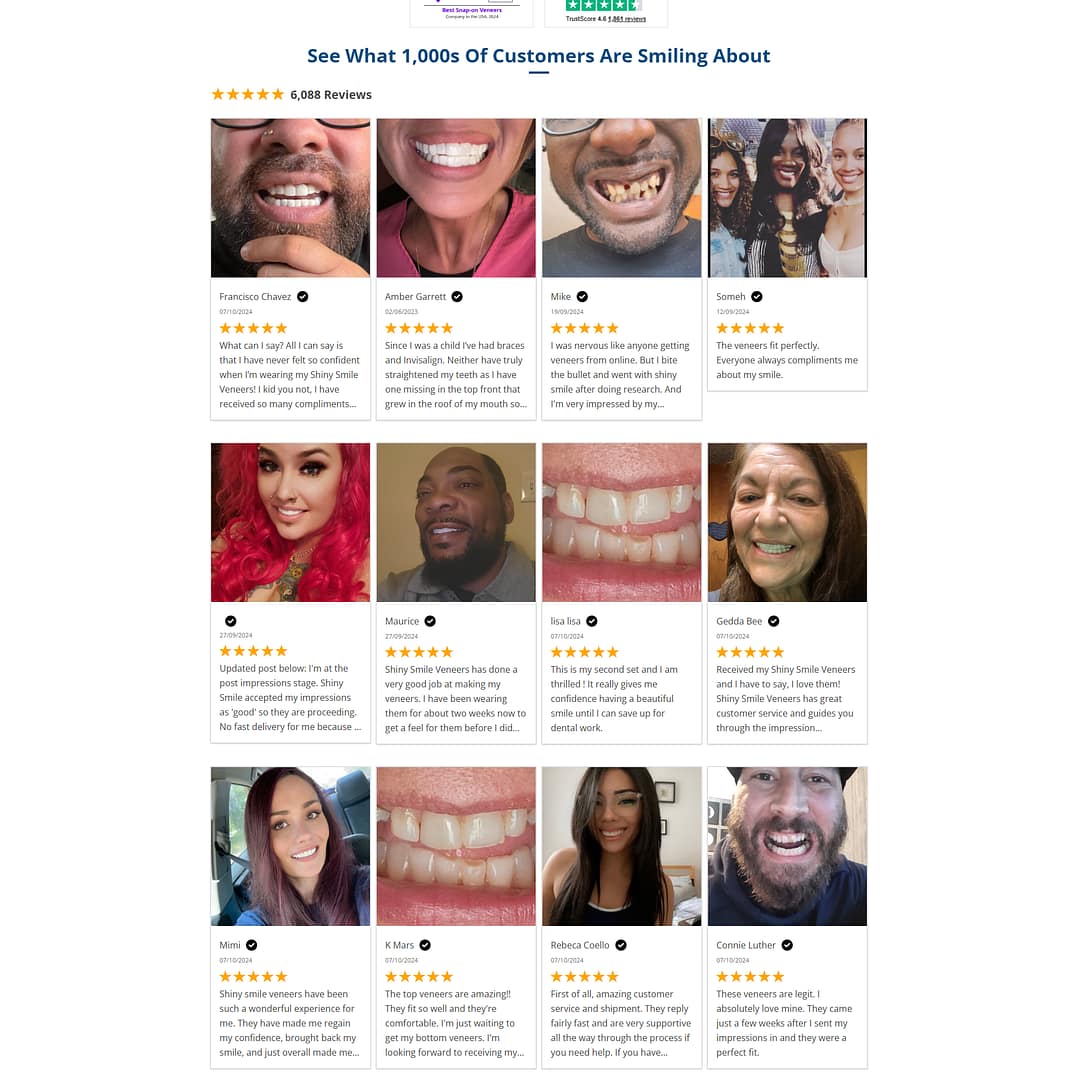
When viewed individually, each Shiny Smile rating appears natural. But when placed side by side, the similarities become more apparent, creating the impression of a shared framework or influence in how feedback is presented.
Timing patterns also contributed to this observation.
Rather than appearing as a steady stream over time, reviews often appeared in clusters—groups of feedback concentrated within relatively short periods. While this can occur during promotional campaigns or periods of increased sales, it can also indicate coordinated review activity.
Perhaps just as notable as what appears in the reviews is what appears to be missing.
In most consumer-facing industries—particularly those involving customization or personal expectations—review ecosystems tend to reflect a range of experiences. Even highly rated products accumulate detailed criticism, nuanced feedback, and a diversity of perspectives over time.
In this case, the proportion of detailed negative feedback appeared relatively limited when compared to the volume of positive entries.
This does not necessarily mean that negative experiences do not exist. It may reflect moderation practices, platform-specific filtering, or the subset of reviews being surfaced most prominently.
However, from a consumer standpoint, the absence of balanced detail can make it more difficult to evaluate the product objectively.
From Volume to Interpretation
At this stage, the analysis moved beyond simple observation and into interpretation.
Individually, none of these factors—high review volume, repeated phrasing, clustered timing, or limited negative detail—are conclusive.
But when viewed together, they introduce a broader question:
Do these reviews function as a fully organic reflection of customer experience, or do they reflect a more structured or managed system?
This distinction is critical.
Because reviews are not just feedback—they are one of the primary mechanisms through which trust is built online.
When that mechanism shows patterns that differ from typical consumer behavior, it becomes important to understand how those patterns are formed.
What This Section Does—and Does Not Claim
This analysis does not claim that Shiny Smile reviews are fabricated.
It does not claim that customers are not satisfied.
It does not claim that the product is ineffective.
What it does highlight is this:
The scale and structure of the review data raise questions that are not easily explained by typical organic growth patterns alone.
And for consumers, that distinction matters.
Because the difference between:
- A large number of independent customer experiences
and - A large number of similarly structured reviews
can significantly influence how trust is formed.
Position Within the Investigation
By this point, several layers of analysis had been completed:
- Company structure and registration
- Team composition and geographic distribution
- Internal review volume and patterns
Each layer introduces its own set of questions.
But taken together, they begin to form a consistent theme:
Not definitive conclusions—but repeated signals that encourage closer scrutiny.
At this point in the investigation, the question was no longer theoretical.
The combination of U.S.-based marketing, Florida-linked registrations, and Egypt-based operational roles created a structure that could not be easily understood through branding alone.
And once that level of disconnect is identified, it becomes difficult to evaluate the company using surface-level signals alone.
Independent Evaluation Is Necessary
If internal reviews raise questions about how customer feedback is presented…
The next step is to examine where many consumers go to validate those reviews:
Third-party ranking websites.
Because if trust is being built externally as well as internally…
It becomes essential to understand whether those external sources are truly independent.
Shiny Smile Review: Quick Verdict
While the number of reviews looks impressive, there is a pattern of unrealistic reviews that some consider questionable. Here is a summary of the reviews we found:
Pros:
– Low upfront cost
– Easy ordering process
Cons:
– Not truly custom-fit
– Durability concerns
– Limited customer support
Best for:
– Temporary cosmetic fixes from a distance
Not ideal for:
– Long-term confidence, close interactions, or daily wear
Section 5: Third-Party Ranking Websites — The Illusion of Independent Validation
By the time most consumers encounter Shiny Smile, they are no longer engaging with advertisements alone.
They are searching for confirmation.
That confirmation often comes in the form of third-party ranking articles—pages that appear in search results for queries like “best snap-on veneers” or “top veneer brands.” These articles present themselves as independent comparisons, designed to help consumers evaluate multiple options and make informed decisions.
Unlike individual customer reviews, which reflect personal experiences, these sites function as curated rankings. They aggregate products, assign relative positions, and often guide the reader toward a recommended choice.
Because of this, they carry a different kind of authority.
They are not just feedback—they are positioning mechanisms.
As part of this investigation, several ranking websites were identified as repeatedly featuring Shiny Smile in prominent positions. Among the most visible were Consumer Life Tips, Trusted Consumers Guide, Consumer Insight Hub, Cool Gadgets Bro, Top Reviewed, and Consumer Guide Reviews.
Individually, each of these sites appears to offer a standalone evaluation. They present lists of top veneer brands, accompanied by summaries, feature comparisons, and recommendations. To a consumer encountering one of these pages in isolation, the experience feels consistent with independent research.
However, when these sites were examined collectively—side by side—a different pattern began to emerge.
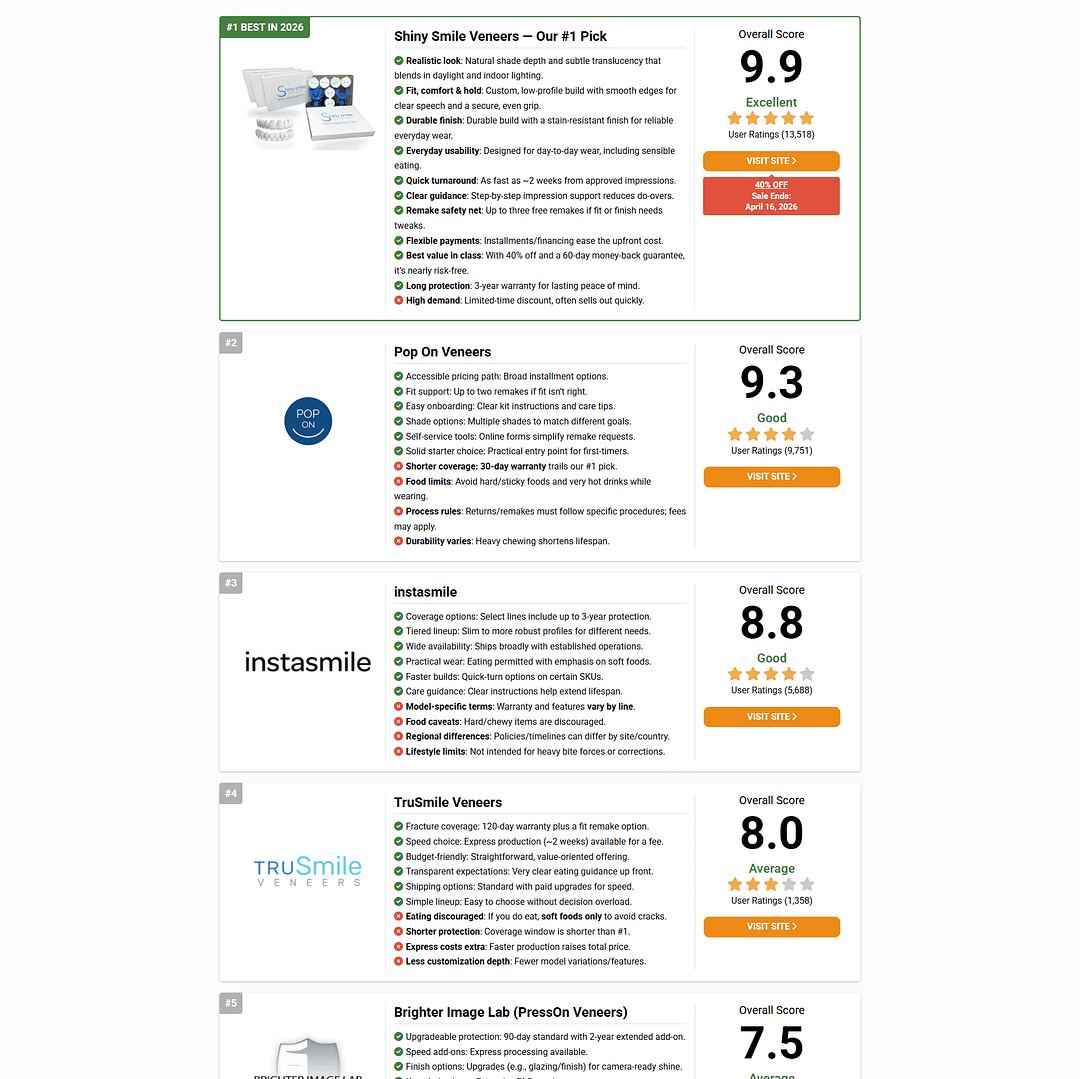
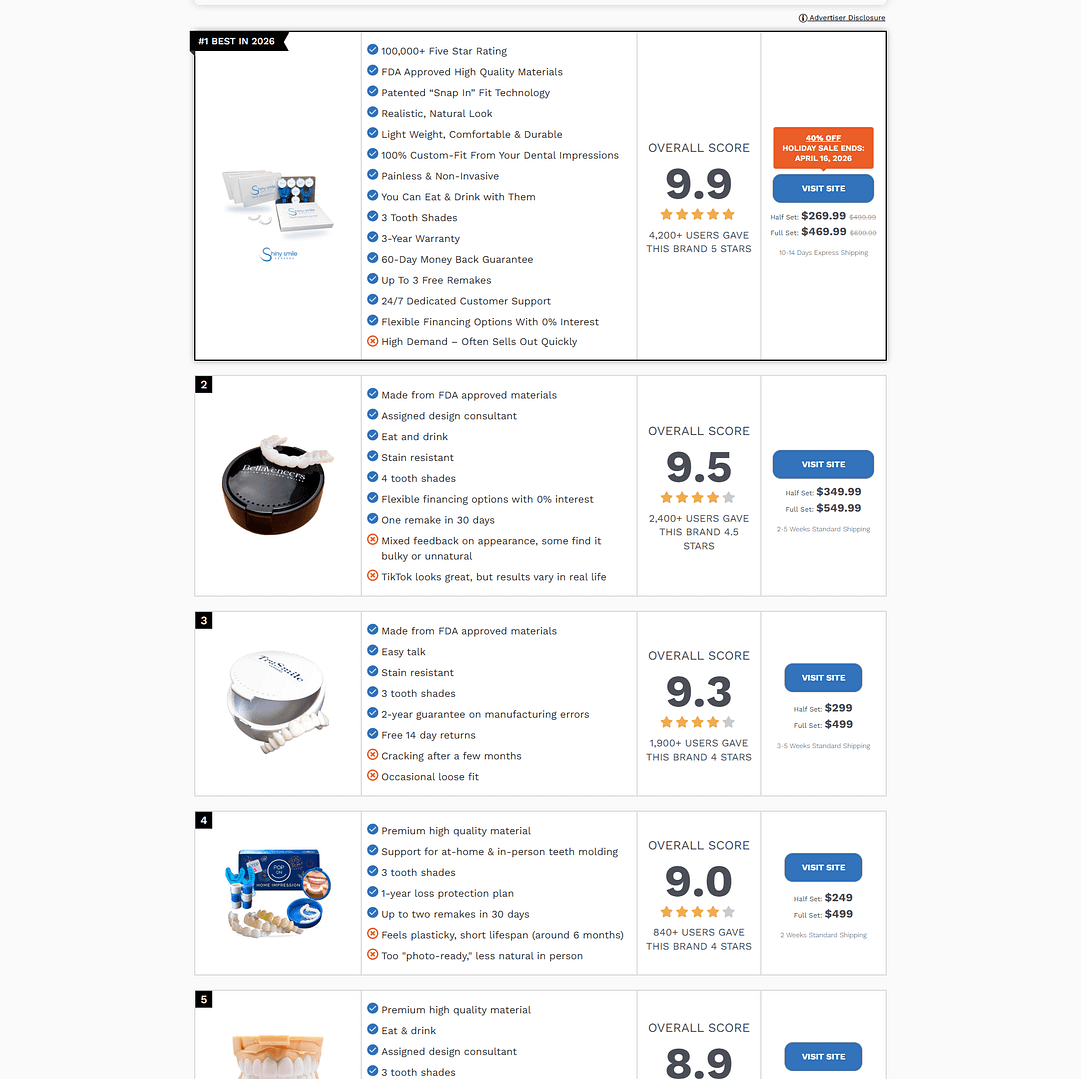
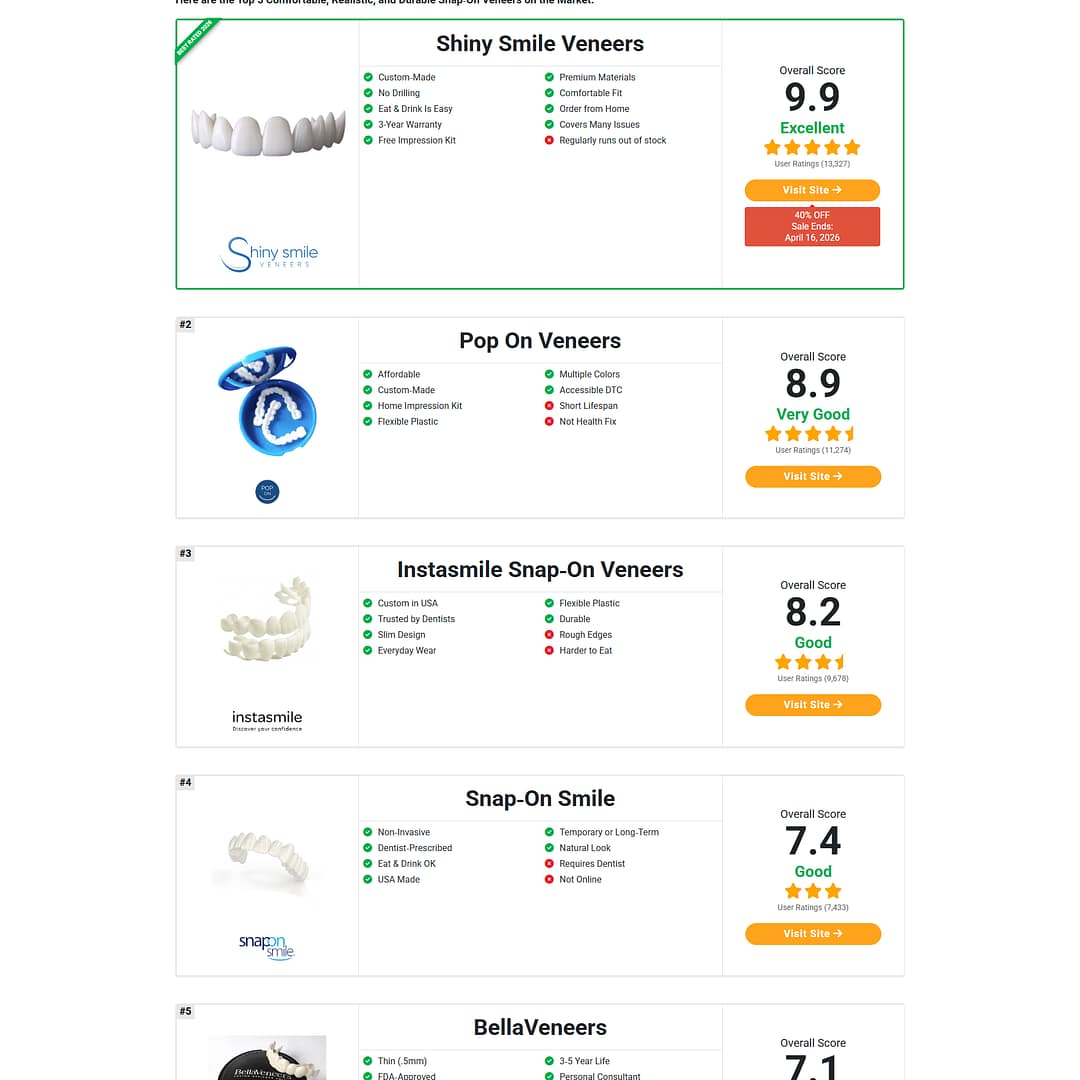
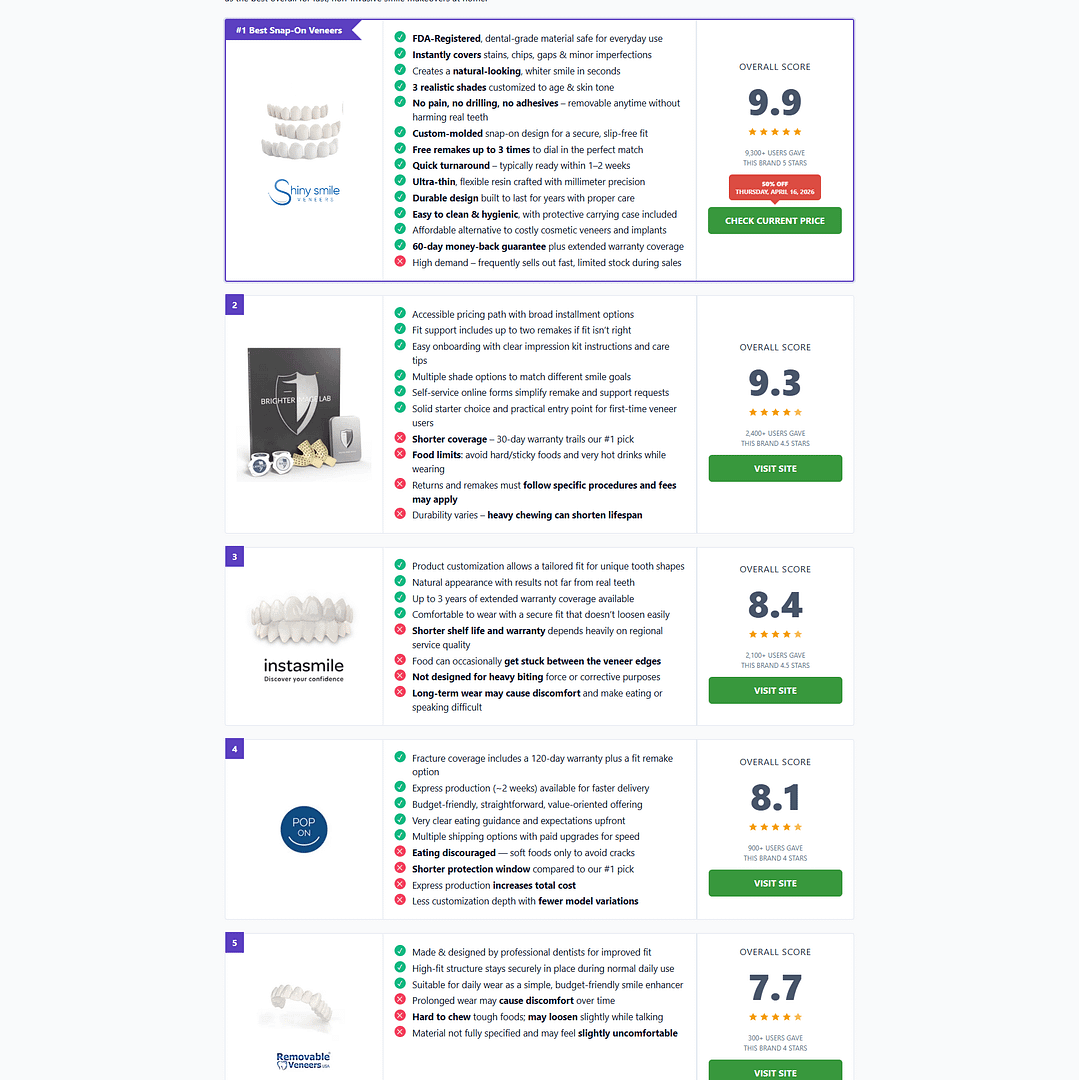
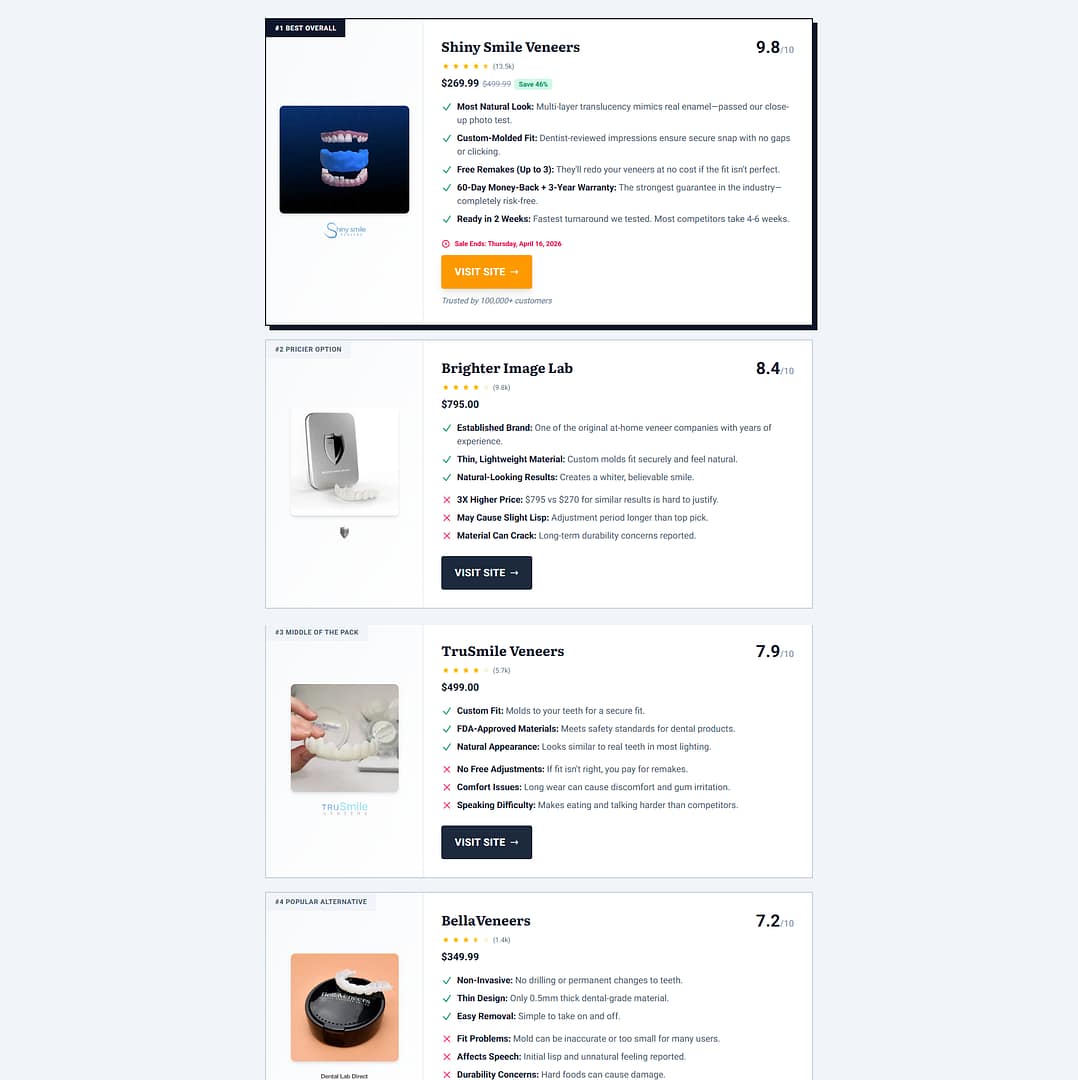
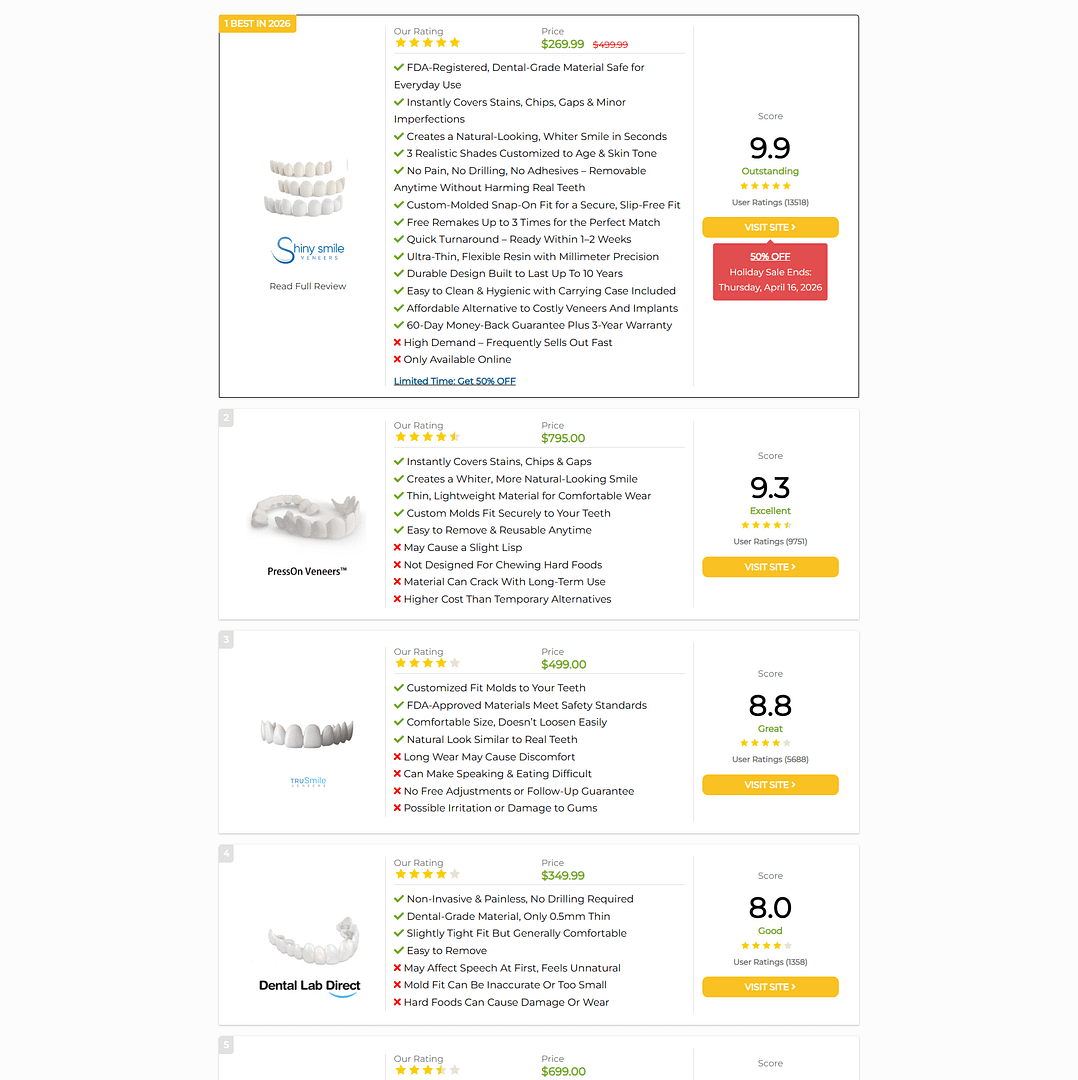
The similarities across these platforms are not limited to general design trends. The structure of the pages follows a remarkably consistent format, with nearly identical sequencing of sections, comparable visual hierarchy, and similar methods of presenting product information.
Descriptions of products—particularly Shiny Smile—often follow the same narrative arc, emphasizing convenience, affordability, and transformation in closely aligned language.
Even the overall framing of the articles appears consistent. Each site presents itself as a helpful guide, yet the organization of information suggests a shared approach to how these rankings are constructed.
Perhaps most notable is the consistency in outcomes.
Across multiple sites, Shiny Smile is positioned near the top of the rankings, often presented as a leading or recommended option. When encountered across several domains, this repetition creates a strong sense of validation.
For a consumer navigating search results, this effect is significant.
Seeing a product recommended once may generate interest.
Seeing it recommended repeatedly across multiple ranking sites creates confidence.
But that confidence depends on a critical assumption:
That each of these rankings was developed independently.
When multiple ranking sites display similar structures, similar language, and similar conclusions, that assumption becomes less certain.
At this stage, the question shifts.
It is no longer simply:
“Is Shiny Smile highly ranked?”
It becomes:
“How independently were these rankings formed?”
This distinction is especially relevant in categories where ranking sites operate within affiliate or performance-based models. In these environments, product placement may be influenced not only by evaluation criteria, but also by monetization structures.
This does not mean that any specific site is intentionally misleading, nor does it invalidate all of the information presented.
Section 6: Customer Experience — What Happens After the Purchase
Up to this point, the investigation has focused on observable patterns—company structure, team composition, review behavior, and third-party positioning.
Each of these elements contributes to how a company is perceived.
But perception alone is not the full picture.
Ultimately, the most important question is not how a company presents itself, but how it performs when a customer engages with it directly.
This is where the investigation began.
Before any records were reviewed or profiles analyzed, a pattern had already emerged through direct communication with individuals who had purchased from Shiny Smile and later sought assistance elsewhere.
Over time, Brighter Image Lab began receiving outreach from these individuals—often without any prompting.
They were not responding to marketing campaigns.
They were not comparison shoppers evaluating multiple brands.
In many cases, they had already made a purchase.
And what they were looking for was not a better offer—but clarity.
Recurring Themes in Customer Communication
As these conversations accumulated, several consistent themes began to surface.
Customers described difficulty reaching customer support, particularly when they had questions about their order or concerns about the process. Responses, when received, were often described as delayed or lacking in detail.
In some cases, individuals expressed uncertainty about who they were communicating with. Interactions did not always feel connected to a clearly identifiable team or process, which contributed to a broader sense of confusion.
Other customers described a lack of transparency during key stages of the experience. This included uncertainty around timelines, production, or next steps—areas where clear communication is typically expected in a customized product process.
Individually, each of these experiences could be attributed to common operational challenges. Delays, miscommunication, and customer service gaps are not uncommon in growing direct-to-consumer businesses.
However, what stood out was not the existence of these issues, but their consistency across unrelated individuals.
From Isolated Experiences to Pattern Recognition
When a single customer reports difficulty reaching support, it may reflect a temporary issue.
When multiple individuals, independently of one another, describe similar challenges—particularly around communication and clarity—it begins to form a pattern.
At this stage, the investigation returned to earlier findings.
The presence of internationally distributed team members, including those involved in both product design and customer support, suggested a potentially complex operational structure. If key functions are distributed across locations without clearly defined communication channels, inconsistencies in customer experience can emerge.
This does not imply that any individual interaction was handled improperly. It does, however, provide context for why customers might experience difficulty obtaining timely or consistent responses.
A Common Realization Among Customers
One of the most consistent statements heard from individuals who reached out was simple:
“We thought all online veneer companies were basically the same.”
That assumption is not unusual—but it is significant.
Because it highlights the gap between how these companies are perceived and how they may actually operate.
And for many customers, that gap only becomes visible after the purchase has already been made.
From a consumer perspective, many brands in this space present similar messaging:
- Convenience
- Affordability
- Transformation without dental visits
Without clear differentiation in structure, process, or transparency, it becomes difficult to distinguish one provider from another.
As a result, purchasing decisions are often based on surface-level signals—reviews, rankings, and marketing presentation.
When those signals appear strong, the underlying company structure may not be examined closely until after the purchase has been made.
Why This Matters
Customer experience is where all other elements of a business converge.
- Marketing creates expectations
- Reviews reinforce trust
- Rankings validate decisions
But the actual experience determines whether those expectations are met.
When multiple customers report difficulty in areas such as communication and support, it raises an important question:
Are the trust signals that influenced the purchase aligned with the experience that follows it?
This is not a question that can be answered through marketing materials or third-party rankings.
It can only be understood through direct interaction.
What This Does—and Does Not Verify
It is important to be precise.
This article does not claim that all Shiny Smile customers have negative experiences.
It does not claim that the company is unable to support its customers.
It does not claim that individual issues reflect intentional actions.
What it does highlight is this:
A consistent pattern of customer-reported challenges related to communication, clarity, and support.
And when those patterns are considered alongside earlier findings—regarding structure, team distribution, and review behavior—they contribute to a broader understanding of how the company operates.
The Final Piece of the Investigation
By this point, the investigation has examined:
- Where the company appears to be based
- Who is involved in its operations
- How it presents itself through reviews
- How it is positioned through third-party rankings
- And how customers describe their experience after purchasing
Individually, each of these areas provides limited insight.
But together, they form a more complete picture. Not a definitive conclusion—but a set of aligned observations that suggest the importance of careful evaluation.
Shiny Smile vs Custom Veneers (Brighter Image Lab)
| Feature | Shiny Smile | Brighter Image Lab |
|---|---|---|
| Fit | Loose fitting | Snug, holds to existing teeth |
| Durability | Bends, cracks, and breaks easily | Lasts up to 5 years or more |
| Material | Melted Coke bottle plastic | High quality used by NASA |
| Support | Limited, if at all | Dedicated client services team |
Frequently Asked Questions About Shiny Smile
Is Shiny Smile safe?
Safe isn’t really the question people should be asking—the better question is: what are you actually putting in your mouth and wearing every day?
This isn’t the medically supervised, precision-crafted solution they project. It’s a removable cosmetic product. For some people, that’s fine. For others, poor fit and bulkiness can create discomfort or frustration pretty quickly.
How long does Shiny Smile last?
Not long enough to justify what most people think they’re buying.
This isn’t a long-term solution—it’s temporary. And that’s where people get caught off guard. They expect durability, consistency, something they can rely on daily… and that’s just not what their product is built for.
Does Shiny Smile look natural?
From a distance? Maybe.
Up close? That’s where the truth shows up.
If something isn’t custom-designed specifically for your face, your bite, and your proportions, it’s going to look off. That’s why people end up saying it looks bulky or “fake.”
Can you eat with Shiny Smile?
You’re not going to forget you’re wearing it, I’ll tell you that.
These aren’t engineered like real teeth. Eating comfortably, speaking naturally, going about your day without thinking about it—that’s not the experience most people are getting.
Is Shiny Smile worth it?
Only if you go in with the right expectations.
If you want a cheap, temporary cosmetic cover (not a veneer) for occasional use, you might feel okay about it.
But if you’re expecting something that feels real, looks natural up close, and actually changes your confidence long-term? That’s where people feel like they made the wrong call.
Conclusion: What This Investigation Suggests
This investigation does not claim that Shiny Smile is a scam.
It does not claim that its products do not work.
What it does show is something more subtle—but just as important:
A pattern of misalignment between how the company is presented and what can be independently verified.
Across multiple areas of analysis—including location, team structure, review patterns, third-party rankings, and customer experience—a consistent theme emerged. Each signal, on its own, may be explainable. But when viewed together, they form a picture that is more complex than the brand’s outward presentation suggests.
And in a category where consumers are making decisions about their appearance, confidence, and finances, that distinction matters.
Because trust is not built on any single signal—whether it is a review, a ranking, or a marketing claim.
It is built on alignment.
Alignment between:
- What a company says
- What can be verified
- And what customers actually experience
When that alignment is clear, confidence follows naturally.
When it is not, uncertainty begins to take its place.
At that point, the responsibility shifts.
Not to the brand—but to the consumer.
To pause.
To ask better questions.
To look beyond surface-level signals and examine the underlying structure more closely.
Because ultimately, the question is not simply:
“Is Shiny Smile legit?”
It is:
“Do I have enough verified information to make a confident decision?”
An Ongoing Investigation
This investigation is not closed.
If you are a current or former Shiny Smile customer and have additional information—whether positive or negative—we encourage you to share your experience.
Greater transparency benefits everyone.
And in an industry where trust plays such a central role, clarity is not just valuable—it is essential.